How to Monitor COPD at Home: Oxygen Levels & Warning Signs
See their oxygen live on your phone — from anywhere. OxyRemote streams readings with instant low‑oxygen alerts for Wellue, O2Ring & Viatom oximeters, so you don't have to be in the room to keep watch.
Download on the App StoreSome links below are affiliate links. As an Amazon Associate, OxyRemote earns from qualifying purchases at no extra cost to you. Picks and opinions are our own.
Chronic obstructive pulmonary disease (COPD) makes breathing harder over time, and oxygen levels are one of the clearest day-to-day signals of how someone is doing. For families helping a loved one manage COPD — especially from a distance — home monitoring can catch trouble earlier and reduce a lot of anxiety. Here is how to monitor COPD at home sensibly: what to track, what the numbers mean, and when to act.
Why home oxygen monitoring helps with COPD
COPD tends to involve good days, bad days, and occasional flare-ups (exacerbations) where breathing suddenly gets worse. A flare-up often shows up as a falling oxygen level and a rising heart rate before it becomes a crisis. Spotting that early can mean the difference between a phone call to the doctor and an emergency room visit — which is exactly where consistent monitoring earns its keep.
What is a normal SpO₂ for someone with COPD?
This is the most important thing to understand: many people with COPD have a lower normal baseline than the general population. While 95–100% is typical for healthy adults, a person with COPD may have a target range set by their doctor that is lower — often somewhere around 88–92%. That range is individual, and only their healthcare provider can set it.
This matters because a reading of 90% might be perfectly normal for one person with COPD and a warning sign for another. The goal of home monitoring is to know your loved one's personal baseline and to notice when they move away from it — not to chase the 95–100% range that applies to healthy lungs.
A crucial caution about supplemental oxygen
Some people with COPD use prescribed supplemental oxygen. If your loved one does, never adjust their oxygen flow based on a home reading without medical guidance. In certain COPD patients, too much oxygen can actually be dangerous. Oxygen settings are a medical prescription — home monitoring is for awareness and for informing the care team, not for self-adjusting therapy.
What to monitor
- SpO₂ against their personal baseline — a sustained drop below their usual range is the key signal.
- Heart rate — a resting pulse that climbs over a day or two can accompany a flare-up.
- Symptoms — increased breathlessness, more coughing, a change in mucus color or amount, swelling, or unusual fatigue.
How to monitor COPD at home, day to day
The value is in consistency, not constant checking. A simple, repeatable routine beats occasional random readings:
- Take a reading at the same time each day — often first thing in the morning, at rest, with warm hands — so you are comparing like with like against their baseline.
- Add an overnight or continuous check if breathing is worse at night; a wearable ring records the whole night, so you see the trend rather than a single number.
- Write the numbers down, or let an app log them, alongside how they felt — so a slow drift over several days is visible instead of lost between readings.
- Agree an action plan with their doctor in advance: the exact readings and symptoms that mean 'call the clinic' or 'seek urgent help', so a bad day triggers a clear step rather than a guess.
None of this requires medical training — just a comfortable oximeter, a fixed routine, and a written plan from the care team. Managing it from another home is covered in monitoring an elderly parent's oxygen remotely.
Warning signs of a flare-up
Treat the following as reasons to contact the care team promptly, and seek emergency help for severe breathlessness, confusion, chest pain, or blue-tinged lips: a sustained oxygen level below the doctor-set range, noticeably harder breathing than usual, needing rescue inhalers far more often, or a marked change in cough or mucus. Written down in advance with your loved one's doctor, these become a clear action plan rather than a guessing game.
How remote monitoring fits in
For family members who do not live with their loved one, remote monitoring closes the distance. With a Bluetooth oximeter and a phone or tablet kept at the patient's home, you can see live SpO₂ and heart rate from anywhere, review trends over time, and set alerts tuned to their personal baseline — for example, a notification if oxygen stays below their target for a sustained period. It will not replace their care team, but it can help you and the patient act sooner and share better information when you do.
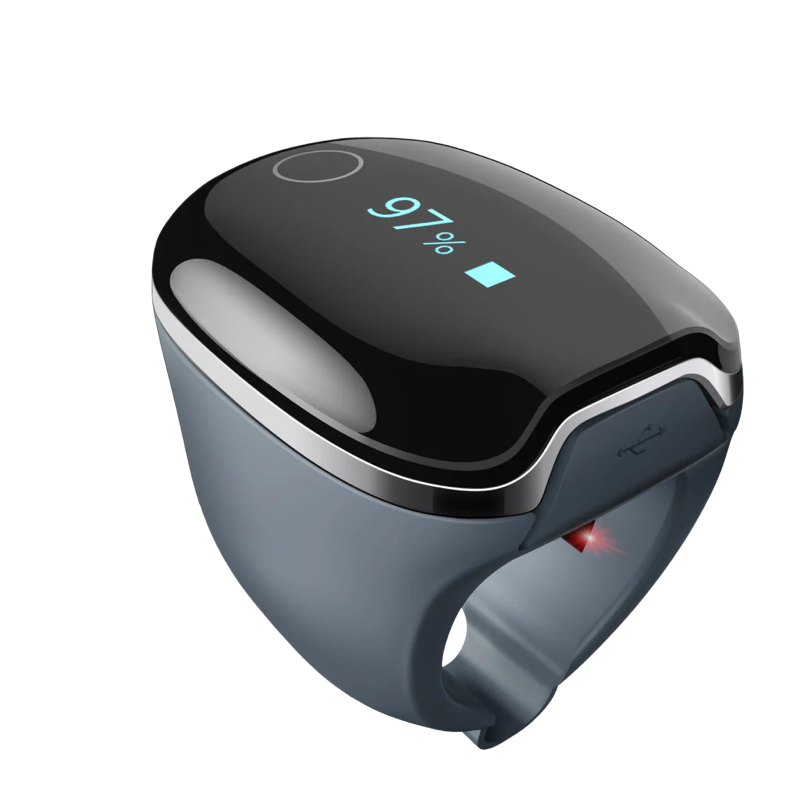
Wellue O2Ring
Works with OxyRemoteA comfortable wearable ring that logs SpO₂ and heart rate continuously through the night, so you see the overnight trend rather than a single daytime number — a wellness and awareness tool for spotting patterns to discuss with the care team, not a diagnostic or alarm device.
Best for: Continuous home & overnight COPD trend awareness
- Records SpO₂ and pulse continuously across a full night instead of a single spot reading, and stores sessions on-device to sync later
- Lightweight ring is far more comfortable for sleep than a clip-on fingertip unit
- A silent vibration can flag a drop without beeping a partner awake
- Works with the ViHealth app and free PC software for exportable PDF/CSV reports you can share with the care team
- The adjustable ring fits only a limited finger-size range, so fit can be hit or miss
- Charges over an older cable and needs daily recharging — a single charge won't span multiple nights
- A consumer wellness device, not a diagnostic tool or medical alarm, with a coarser sampling interval than newer models
A note on medical care
This guide is general information, not medical advice. COPD management is highly individual and should always be directed by a qualified healthcare professional. Use home and remote monitoring to support that care and to stay informed — not to diagnose, treat, or adjust therapy on your own.
Watch over them from anywhere
OxyRemote streams live SpO₂ and heart rate to your phone, with custom alerts — using a supported Bluetooth pulse oximeter.
Download on the App Store