Using a Pulse Oximeter for Sleep Apnea: Tracking Oxygen Overnight
See their oxygen live on your phone — from anywhere. OxyRemote streams readings with instant low‑oxygen alerts for Wellue, O2Ring & Viatom oximeters, so you don't have to be in the room to keep watch.
Download on the App StoreSome links below are affiliate links. As an Amazon Associate, OxyRemote earns from qualifying purchases at no extra cost to you. Picks and opinions are our own.
If you suspect sleep apnea — your own, a partner's, or a parent's — a recording pulse oximeter is one of the most accessible ways to gather real overnight data. It will not diagnose the condition, but it can reveal a telling pattern in blood oxygen that is worth bringing to a doctor. Here is how to use one well, and how to read what it shows without jumping to conclusions.
One thing up front: a home oximeter is a screening and awareness tool, not a diagnosis. Sleep apnea is formally diagnosed by a sleep study, which measures far more than oxygen. If a clinician has suggested recording your oxygen first, our guide to the overnight pulse oximetry test at home covers what to expect. Treat overnight readings as a reason to start a conversation, not as a verdict.
How sleep apnea shows up in oxygen data
In obstructive sleep apnea, the airway repeatedly narrows or closes during sleep, briefly interrupting breathing. Each pause can be followed by a dip in blood oxygen, then a recovery as breathing resumes. Over a night, this produces a distinctive sawtooth pattern — drop, recover, drop, recover, sometimes dozens or hundreds of times. That repeating shape, especially alongside loud snoring, gasping awakenings, or heavy daytime sleepiness, is the classic oximetry signature. Our guide on why SpO₂ drops during sleep explains how to tell these clusters from the mild, scattered dips that are a normal part of sleep.
What the ODI means
Many overnight oximeters report an oxygen desaturation index, or ODI: the average number of times per hour your oxygen dropped by a set amount (commonly 3% or 4%) below baseline. A higher ODI means more frequent desaturations. It is a useful summary number, but it is not the same as the AHI (apnea–hypopnea index) a sleep lab uses to grade apnea severity — the ODI only counts oxygen dips, while the AHI also accounts for breathing events that do not always cause a measurable desaturation.
Which numbers tend to matter
- Depth — repeated dips that reach the high or even mid 80s draw more attention than shallow wobbles. See what oxygen level is too low.
- Frequency — a higher ODI, with dips clustering through the night rather than appearing once or twice.
- Consistency — a pattern that repeats across several nights, not a one-off bad night that could be a cold, alcohol, or sleeping position.
Why an oximeter is not a diagnosis
A pulse oximeter measures oxygen and pulse — it cannot see airflow, breathing effort, brain activity, or the difference between obstructive and central events. Some apnea events do not produce a large oxygen dip at all and would be missed entirely. That is why normal-looking oximetry does not rule sleep apnea out, and why a worrying pattern still needs a proper sleep study to confirm and grade. The oximeter's job is to flag a pattern worth investigating, with objective data in hand.
Choosing a device for overnight apnea tracking
Comfort decides whether you actually collect data, because a fingertip clip tends to fall off or wake you. A ring-style or wrist-worn monitor that records continuously and stays put all night is far better suited to this. Our comparison of overnight oximeters lays out the common options, and the overnight monitoring setup guide covers how to wear it and read your first nights.
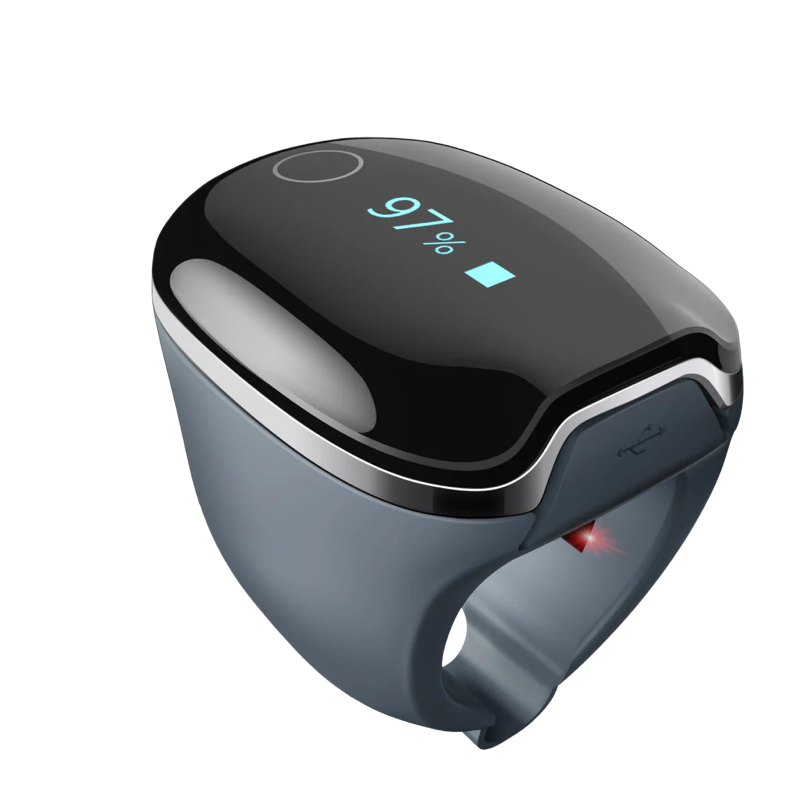
Wellue O2Ring
Works with OxyRemoteA comfortable ring that logs SpO2 and pulse all night and gives a silent vibration when oxygen drops, which makes it a practical way to track and observe your overnight breathing trends over time. It is a wellness tracker, not a diagnostic device — consult a doctor for any diagnosis.
Best for: Comfortably observing overnight SpO2 trends
- Records SpO2 and pulse continuously across a full night rather than a single spot reading, and stores the session on the ring so it can sync later instead of staying tethered to your phone
- A soft ring is far easier to sleep in than a clip-on fingertip unit, and it is well established in the sleep community
- A silent, multi-level vibration nudges you when oxygen drops, so it can prompt a position change overnight without beeping a partner awake
- Works with the ViHealth app and free PC software for exportable PDF and CSV reports you can review or share with a clinician
- The adjustable ring still fits only a limited finger-size range, so the fit can be hit or miss
- It charges over an older cable and needs recharging most days, since one charge does not span several nights
- It is a wellness device, not a diagnostic tool: it cannot confirm or rule out sleep apnea, and its sampling interval is coarser than some newer models
Watching over a partner or parent with apnea
Apnea often gets noticed by the person sleeping next to the patient, not the patient themselves — and it gets more worrying when that person lives in another home. With OxyRemote streaming a supported oximeter, family members can review the night's pattern from their own phone and get an alert if oxygen crosses a chosen threshold, rather than waiting for a morning report. For an older parent, the remote caregiving guide walks through the full setup.
When to see a doctor
Bring your recordings to a doctor if you see repeated overnight desaturations, a clear sawtooth pattern, or loud snoring and daytime sleepiness alongside the data — and certainly if a partner has witnessed you stop breathing in your sleep. A specific picture (the overnight graph, the ODI, the lowest values) makes that appointment far more productive, and may lead to a formal sleep study, which remains the gold standard.
The bottom line
A recording pulse oximeter is an excellent first step for sleep apnea: it is cheap, easy, and surprisingly revealing of overnight oxygen patterns. Just remember its limits — it screens, it does not diagnose. Use it to gather a few nights of consistent data and to take a real, objective picture to a clinician, who can decide what the pattern means and whether a sleep study is the next step.
Watch over them from anywhere
OxyRemote streams live SpO₂ and heart rate to your phone, with custom alerts — using a supported Bluetooth pulse oximeter.
Download on the App Store